

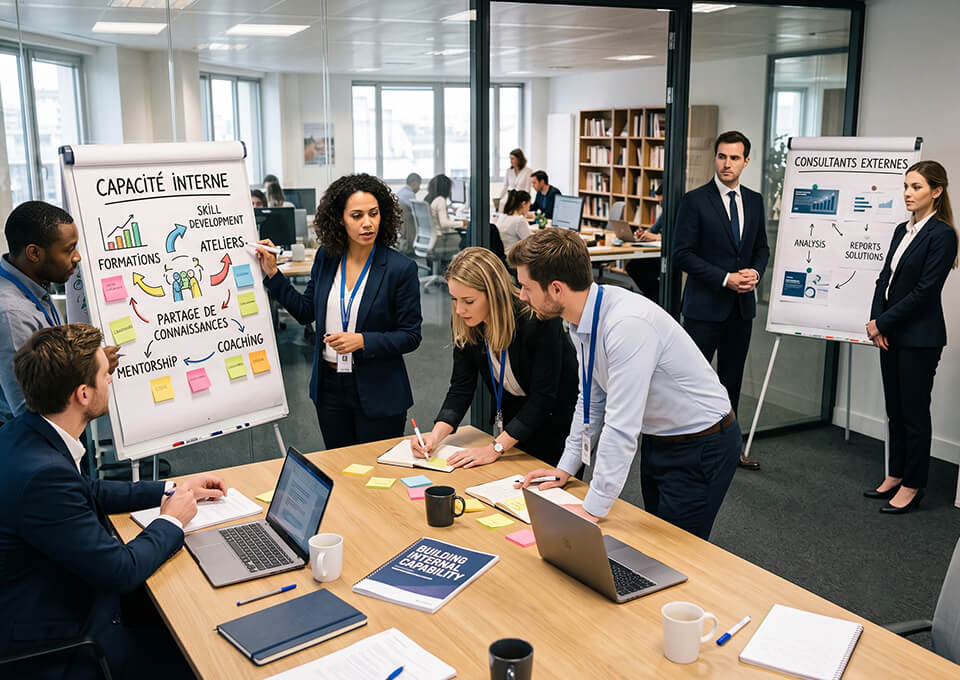
Every real estate organisation operating in Mauritius, whether a family-owned development group, a commercial property investor, or a hospitality operator, faces a fundamental strategic question about how it sources the expertise it needs to operate effectively: which capabilities should be built internally, developed within the organisation’s own team through hiring, training, and sustained practice, and which capabilities should be accessed through external consultants and advisors who are engaged as needed for specific projects or functions?
This build-versus-buy question is not unique to real estate, it is a strategic choice that all organisations face. But in the Mauritius real estate context, it has particular nuances driven by the specific characteristics of the island market: the limited depth of available local talent in some specialist disciplines, the relationship-intensive nature of local market activity, the importance of institutional memory in a market where long-term presence creates genuine competitive advantage, and the cost and logistical implications of accessing specialist expertise from outside the island. The Apavou Group, with more than four decades of experience building organisational capabilities in the Mauritius real estate market under the leadership of founder Armand Apavou, expressed across major developments including Plaisance Mall, Terre d’Été, and The Cube, has developed a practical and tested perspective on this strategic question.
The case for building internal capability
The primary argument for building capability internally rather than accessing it through external consultants is that some types of knowledge and capability genuinely cannot be adequately provided by external advisors, however competent. The most important category is institutional knowledge, the deep, accumulating understanding of the Mauritius market, its dynamics, its regulatory environment, its community relationships, and its specific construction and management challenges that develops through sustained direct engagement and that cannot be replicated through project-by-project external engagement.
External consultants, by definition, are not continuously engaged with the organisation and its specific context. They bring general expertise and broader market perspective, but they necessarily lack the specific contextual knowledge that comes from years of continuous engagement with the Mauritius market from inside the organisation. For capabilities where this contextual specificity is critical, where the value of the capability depends substantially on deep familiarity with the organisation’s specific assets, relationships, and strategic position, internal development is almost always superior to external reliance.
The categories of capability that must be internal
In a Mauritius real estate organisation like the Apavou Group, certain capability categories must be maintained internally if the organisation is to perform at the level its strategic ambitions require. Asset management, the ongoing oversight of how specific properties are performing, the identification and resolution of asset-level issues, and the relationship management with tenants, operators, and local communities, requires deep asset-specific knowledge and continuous engagement that cannot be effectively delegated to external consultants without loss of quality and responsiveness.
Strategic investment analysis, the evaluation of potential acquisitions, development opportunities, and disposal candidates against the portfolio’s strategic objectives and the group’s investment thesis, requires an integration of market knowledge, portfolio context, and strategic judgment that is most effectively performed by internal professionals with direct accountability for portfolio performance. External advisors can contribute valuable perspectives and market intelligence to this function, but the analytical integration and strategic decision-making must remain internal.
The knowledge accumulation advantage of internal capability
One of the most powerful arguments for building internal capability in the Mauritius real estate context is the knowledge accumulation advantage that internal expertise provides. External consultants’ knowledge of the organisation and its context resets with each engagement; they come in, complete the assignment, and depart, carrying their learning with them. Internal professionals accumulate knowledge continuously; each project, each negotiation, each regulatory engagement, each tenant conversation adds to a growing body of specific, contextual knowledge that makes future work more effective. Over time, this knowledge accumulation effect compounds significantly, creating an internal capability that becomes increasingly difficult for external consultants, however competent, to match in quality and efficiency for work that requires deep contextual knowledge.
The case for external consultants
The argument for relying on external consultants for specific functions is equally compelling in the right circumstances. The strongest case for external engagement is for specialist technical expertise that is needed periodically rather than continuously, where the volume of work does not justify maintaining the specialist capability internally, and where the specific expertise required is sufficiently specialised that external professionals who work across multiple clients and contexts typically maintain a higher level of technical currency than internal professionals with more limited exposure.
Technical disciplines like structural engineering, environmental impact assessment, specialist legal advice on complex transactions, and certain areas of financial modelling and capital markets advisory are examples where external specialist engagement typically provides better quality at lower total cost than attempting to build and maintain equivalent internal capability. In the Mauritius real estate context, where the total volume of specialist work may not justify full-time internal staffing for highly specialist disciplines, the external model for these technical functions is often the most economically rational approach.
Using external consultants to augment rather than replace internal capability
The most effective approach to the build-versus-buy decision in Mauritius real estate organisations is not a binary choice between all-internal and all-external capability, but a deliberate blending strategy that builds strong internal capability in the domains where institutional knowledge and continuous engagement create the most value, while selectively accessing external expertise for specialist disciplines where depth of technical specialisation is more important than contextual continuity.
In this blended model, external consultants function most effectively as augmenters of internal capability rather than replacements for it. The external structural engineer who works alongside the internal development management team brings specialist technical knowledge that the internal team does not possess. The internal team brings the contextual knowledge of the project, the organisation’s standards and preferences, and the relationship management with regulatory bodies and contractors that the external specialist cannot provide. The combination is more powerful than either alone, but only if the internal team has sufficient capability to direct, integrate, and quality-control the external specialist’s contribution.
The risk of over-reliance on external consultants
Over-reliance on external consultants, outsourcing so much of the organisation’s analytical and decision-support work that internal capability atrophies, creates several significant organisational risks. The most immediate is the loss of quality control. When internal professionals lack sufficient expertise to evaluate and challenge the work of external consultants, they are unable to identify errors, biases, or limitations in the consultant’s work product. The organisation effectively becomes dependent on the quality and integrity of the external provider without the internal competence to verify that quality independently.
A second significant risk is the erosion of institutional memory and competitive advantage. External consultants carry their knowledge away when the engagement ends. As organisations increasingly rely on external expertise rather than building internal capability, the accumulated knowledge that creates sustainable competitive advantage gradually moves outside the organisation’s boundaries, becoming accessible to competitors who engage the same advisors, rather than remaining a proprietary advantage embedded in the organisation’s own team.
Building capability in the Mauritian talent market
Developing internal capability in the Mauritius real estate market requires navigating the specific characteristics of the island’s professional talent market, which is sophisticated in some disciplines and limited in others, and which is subject to competitive demand from the island’s growing financial services, technology, and business services sectors. Real estate-specific expertise at the senior level is relatively concentrated among a small professional community on the island, and competition for the most capable professionals is real.
For the Apavou Group, building and retaining internal capability has required deliberate investment in the development of promising local professionals, providing structured training and development pathways, exposure to challenging work across the full range of the group’s activities, mentoring relationships with senior professionals, and competitive compensation that reflects the market value of genuine expertise. This investment in internal capability development is not a cost, it is one of the most reliable investments the organisation can make in the long-term quality and sustainability of its competitive position in the Mauritius real estate market.
Internal capability as the foundation of competitive advantage
For Mauritius real estate organisations with serious long-term ambitions, the quality of internal capability is one of the most important determinants of whether they can maintain a genuinely competitive position in a market that is becoming increasingly sophisticated and increasingly contested. External consultants can supplement and augment internal capability, but they cannot substitute for it in the domains where contextual knowledge, institutional memory, and continuous engagement create the most value. For the Apavou Group, the investment in building genuine internal expertise across its development and investment activities in Mauritius has been as important to the group’s sustained competitive position as its physical portfolio of assets. It is the organisational infrastructure on which continued excellence is built.
 Previous Post
 Next Post